
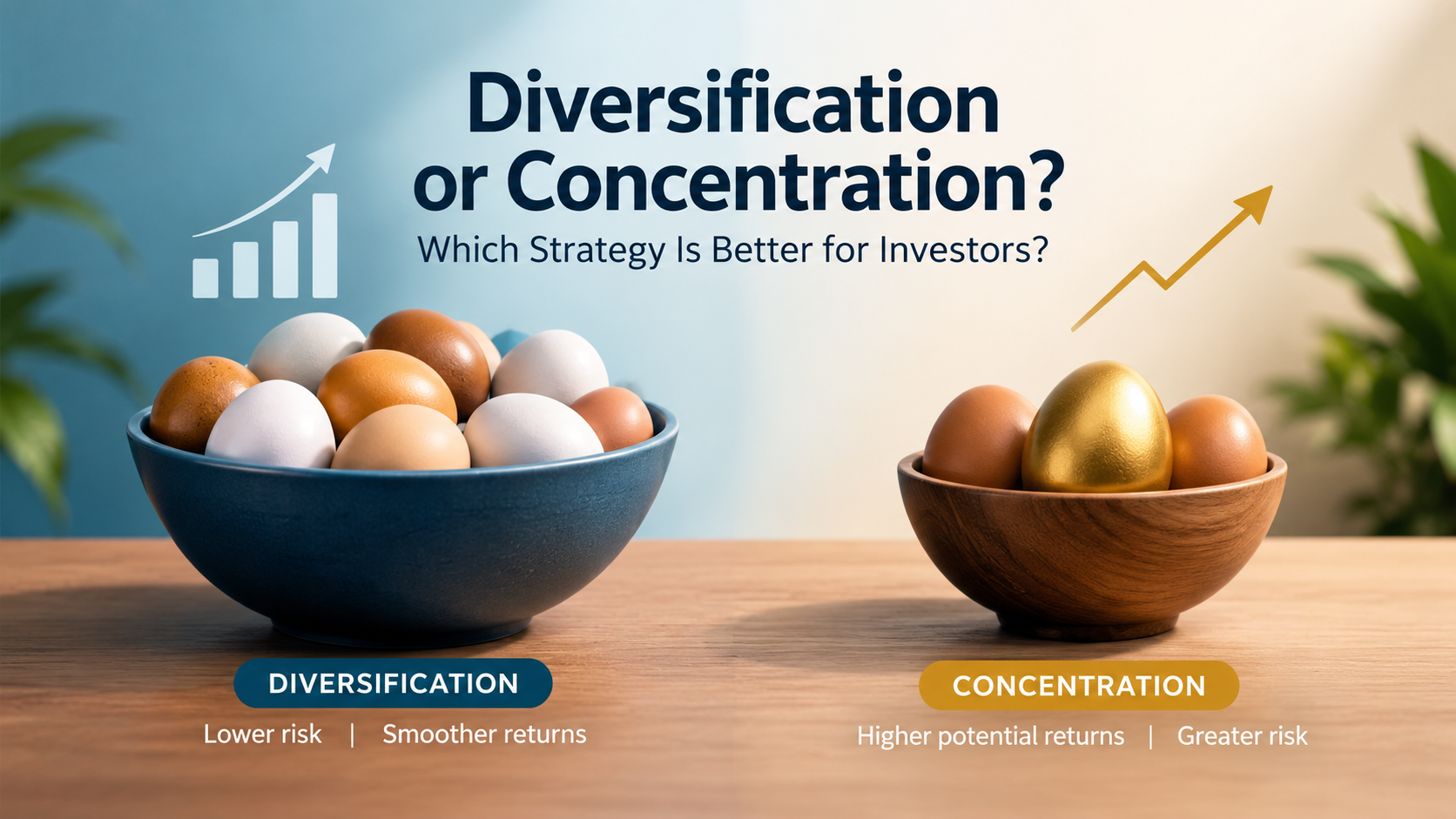
“Don’t put all your eggs in one basket.” If you have listened to an investment advisor for at least 10 minutes, you are probably familiar with this statement. It’s no exaggeration to say diversification has become an article of faith in modern portfolio management.
Is that not the conclusion of Harry Markowitz’s popular 1952 article (Portfolio Selection) and the Modern Portfolio Theory it birthed?
Yet, many investors insist that concentration is the way to go. “Going big on a few bets is the way you make money in the market,” they insist.
Is that not what Warren Buffett was affirming when he said, “Diversification is protection against ignorance. It makes little sense if you know what you are doing.” “Opportunities come infrequently,” he also said. “When it rains gold, put out the bucket, not the thimble.”
So, which is it: Reducing portfolio risk with diversification or maximizing opportunities (and returns) with concentration? Asked differently, is diversification the lifeline for those navigating the stock market maze without a compass, or the smart effort to ensure there’s an egg to eat even on bad days?
We’ll seek to answer these questions in this article.
The case for concentration
Higher returns
The main argument for portfolio concentration is that it can deliver higher returns and help build wealth faster.
“Investment portfolios that obtain the highest returns for investors are not usually widely diversified,” according to Investopedia. “Those with investments concentrated in a few companies or industries are better at building vast wealth.”
They include William O’Neil, Jesse Livermore, and Gerald Loeb as examples of those who have taken this approach.
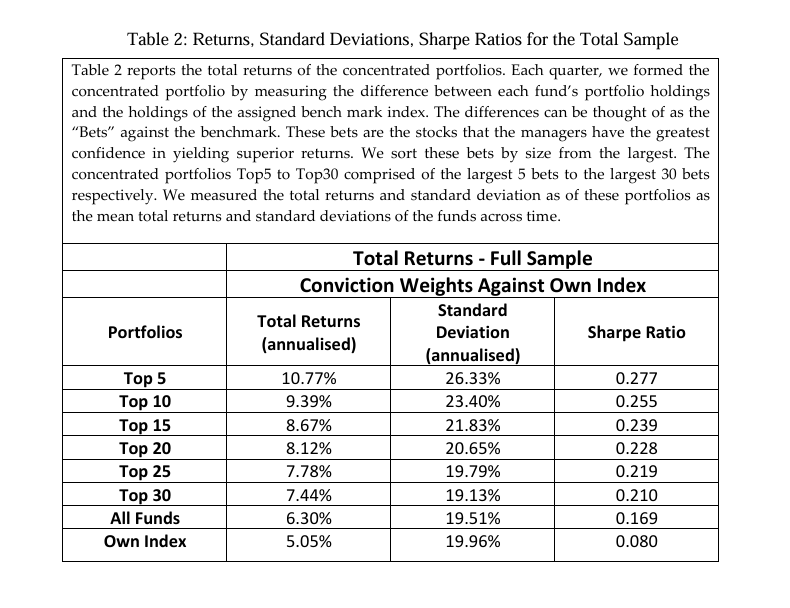
Researchers writing for The Paul Woolley Center for the Study of Capital Market Dysfunctionality also found that concentrated portfolios outperformed diversified portfolios. This was in a study of 4,723 actively managed mutual funds in the US, using data between 1990 and 2009.
Performance of concentrated and diversified portfolios between 1990 and 2009
Source: University of Technology Sydney
They constructed the concentrated portfolios by comparing a mutual fund to its index and identifying holdings in the fund that are not in the index. They treated these holdings as the fund managers’ bets (since they were not required by the index) and created portfolios of the top 5, 10, 15, 20, 25, and 30 bets (sorted by size).
“The more concentrated the portfolio, the better the performance as we see a progressive decrease in realized returns as the concentrated portfolios are expanded from five stocks to 30 stocks,” they commented.
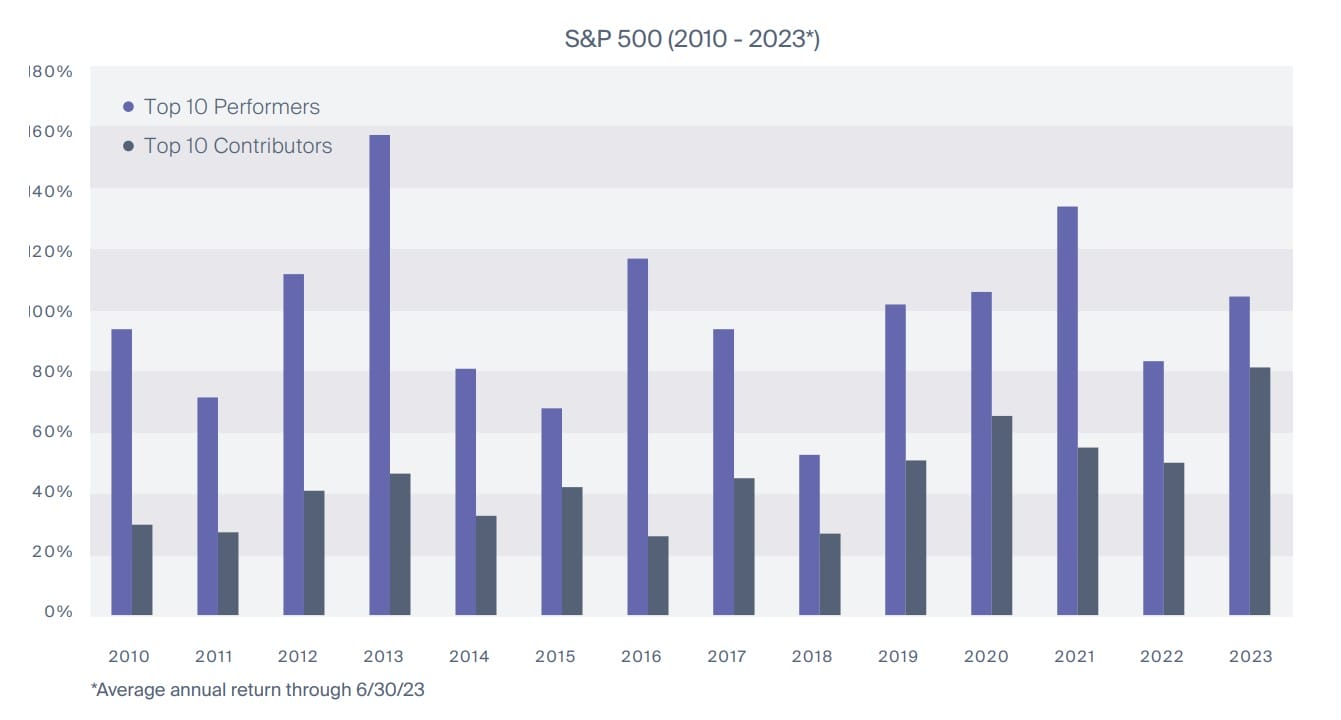
Furthermore, between 2010 and 2023, the top 10 performers of the S&P 500 Index outperformed the top 10 contributors to the index, according to a study by Gresham Partners, a wealth planning firm.
Top 10 Performers of the S&P 500 Index Vs Top 10 Contributors, 2010-2023
Source: Gresham Partners
“This reiterates,” they concluded, “that, if executed proficiently, there are abundant opportunities to surpass the return of the index itself.” In other words, a strategy that focuses on picking the best stocks is superior to one that mainly tracks the index.
Beating the market
Furthermore, concentration is the only way mutual funds can justify their existence, since they need to beat the market (by a margin higher than the difference between their expense ratios and those of passive funds) to be more appealing than passive investing.
On the other hand, a diversified strategy means mutual funds replicating index returns while charging higher fees than passive funds. Where then is the appeal for investors to embrace active management?
No wonder Brett Robertson, president of Dallas-based Richmont Investment Management, insists that diversification is a recipe for mediocrity.
More focused research efforts
A fund manager who has to keep a tab on 30 stocks may not give each stock the attention it deserves compared to one who manages only ten.
“I didn’t make a conscious decision in 1987 to run concentrated portfolios,” said John Fisher, the CEO of Wilson/Bennett Capital Management, an investment management firm. “The analytical process — valuing businesses and pieces of businesses — lends itself to a concentrated approach. We get to know the companies well, and if you’re following 12 or 13 stocks, it’s much easier to know what’s going on in the underlying businesses.”
In other words, with fewer stocks, it is easier to conduct the kind of thorough analysis that a Benjamin Graham or Warren Buffett would approve.
Riding with the best
In Only the Best Will Do, Peter Seilern, founder of Seilern Investment Management, argues for buying only exceptional businesses with durable competitive advantages.
“Constructing a portfolio of what he calls quality growth stocks is the only true way to minimize the risk of losses while simultaneously maintaining a high probability of above-average long-term returns,” said Jonathan Davis, an investment expert, in the foreword to the book.
This idea of focusing on only the best companies is easier to implement with portfolio concentration than diversification. “If one manager holds 40 stocks, you might get his 10 best ideas, while the other 30 are filler,” said Greg Horne, president of Ashbridge Investment Management. “I would just as soon get the filet.”
In essence, mutual funds that use portfolio diversification must include some stocks because they are part of a given index, not because they are part of “the best.”
The case against concentration
Failure of active funds to outperform the market
While arguing for the benefits of portfolio concentration, Lauren Rublin, senior managing editor at Barron’s, a financial magazine, admitted: “Screening Morningstar’s Principia Plus database turned up only three mutual funds with 25 or fewer stocks that beat the S&P 500 over three- and five-year periods.”
Advocates of passive investing and diversification have pressed this wound of portfolio concentration over the years. Of course, one can point to some outstanding funds that have outperformed, but the average investor should care more about average performance over the long term.
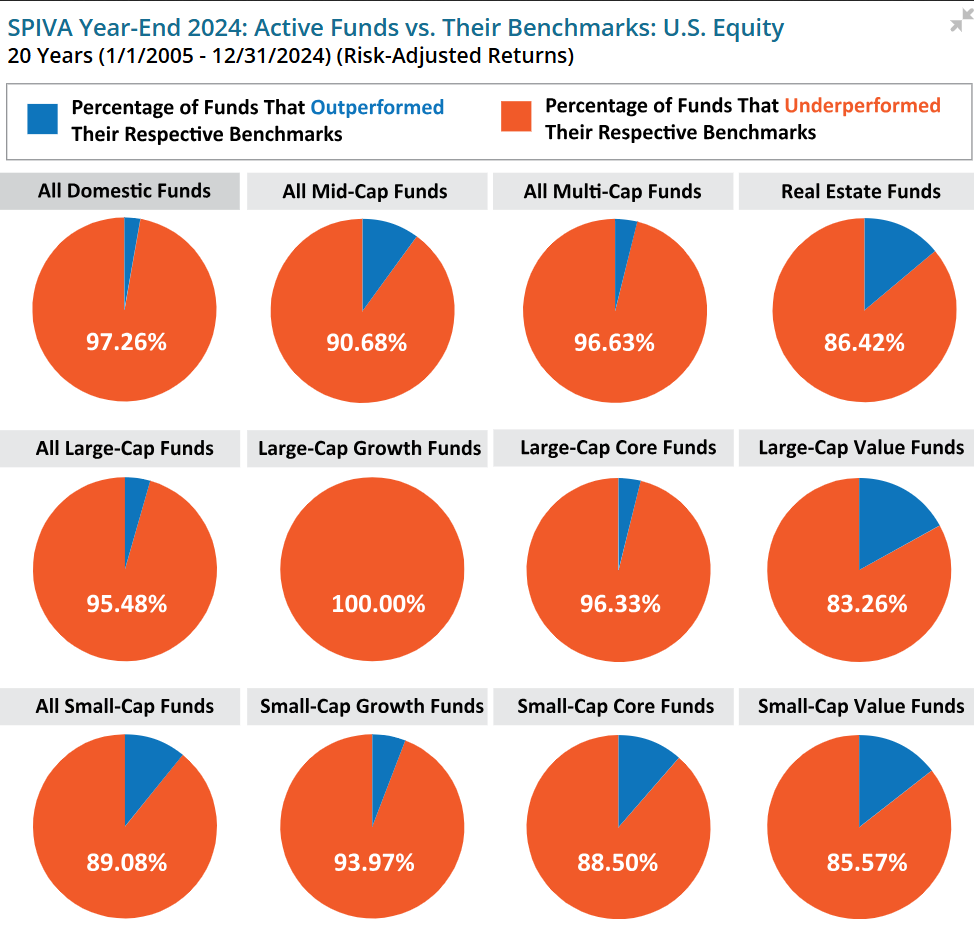
“A lack of consistency by active fund managers in outperforming their respective indexes has been a constant theme of S&P Global’s SPIVA U.S. Scorecard,” according to Index Fund Advisors, a financial advisory firm.
The latest installment of the SPIVA year-end report showed that 97.26% of domestic US equity funds underperformed their benchmarks over the 20 years ending 31st December 2024.
Performance of actively managed funds against their benchmarks, Jan 2005 to Dec 2025
Source: Index Fund Advisors
If beating the market is the point of portfolio concentration, then this consistent underperformance by most of the actively managed funds remains a major weakness.
Higher risk
Portfolio concentration requires you to be very good at picking the best stocks. But is it not always possible that one pick will turn out to be the wrong one?
Rublin grants this point: Portfolio concentration is riskier if you define risk as volatility and measure it by standard deviation.
However, many advocates of portfolio concentration will disagree with this CAPM-inspired definition of risk. “As soon as some people see higher volatility numbers in their portfolios, their minds shut down, and they see risk,” said Robertson. “To me, if 20 years from now you haven’t met your investment goal, that is the real risk.”
In other words, the true investment risk is failure to achieve your investment goals. Since he believes the higher returns from portfolio concentration make it more likely you will achieve those goals, he considers it less risky.
This aligns with Seliern’s argument that the true measure of risk is permanent loss of capital.
Like Robertson, he also sees concentration as the superior approach since it minimizes the risk of a permanent capital loss. “When thinking about risk, it is far more important for the investor to be protected against losing money irrevocably than it is to worry whether the price of what he owns is up or down from one day to the next,” he said.
For long-term investors, then, portfolio concentration is the less risky approach.
The case for diversification
Higher long-term returns
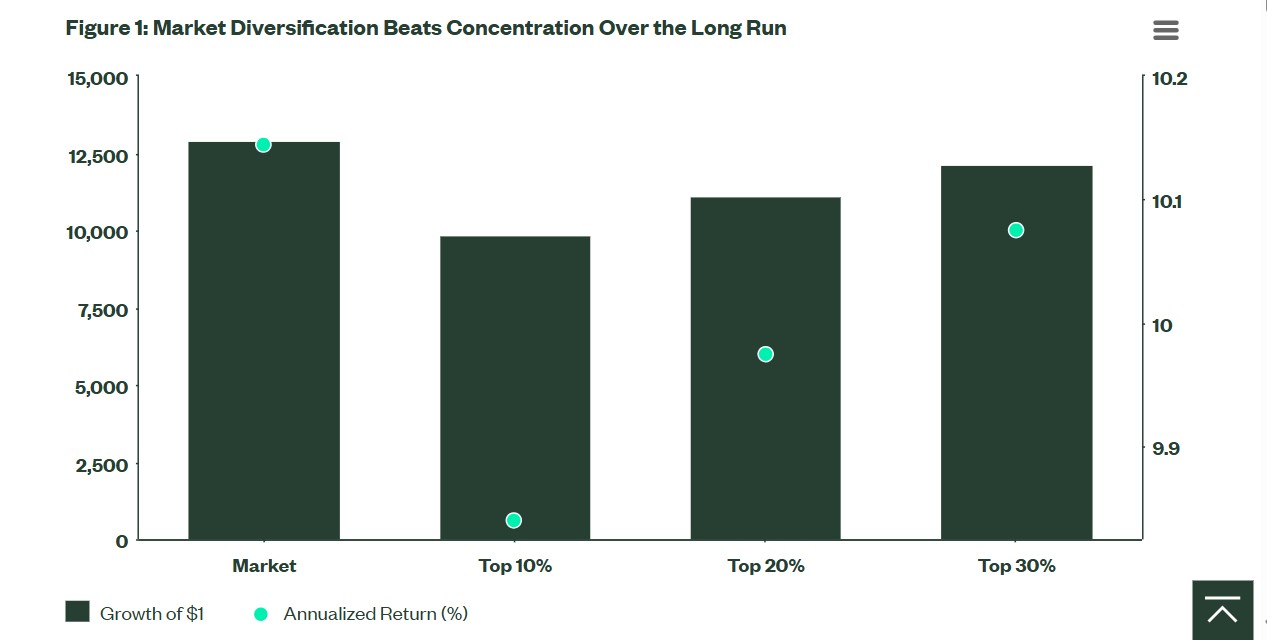
Diversified portfolios produce higher long-term returns, according to a study by Matthew Bartolini, Head of SPDR Americas Research, the market analysis branch of State Street Global Advisors.
As the chart below shows, the market’s annual average return (10.14%) is higher than that of all three selected concentrated portfolios. Interestingly, the more concentrated the portfolio, the lower the average annual return.
Annualized average annual return of a market portfolio vs 3 concentrated portfolios
Source: State Street Global Advisors
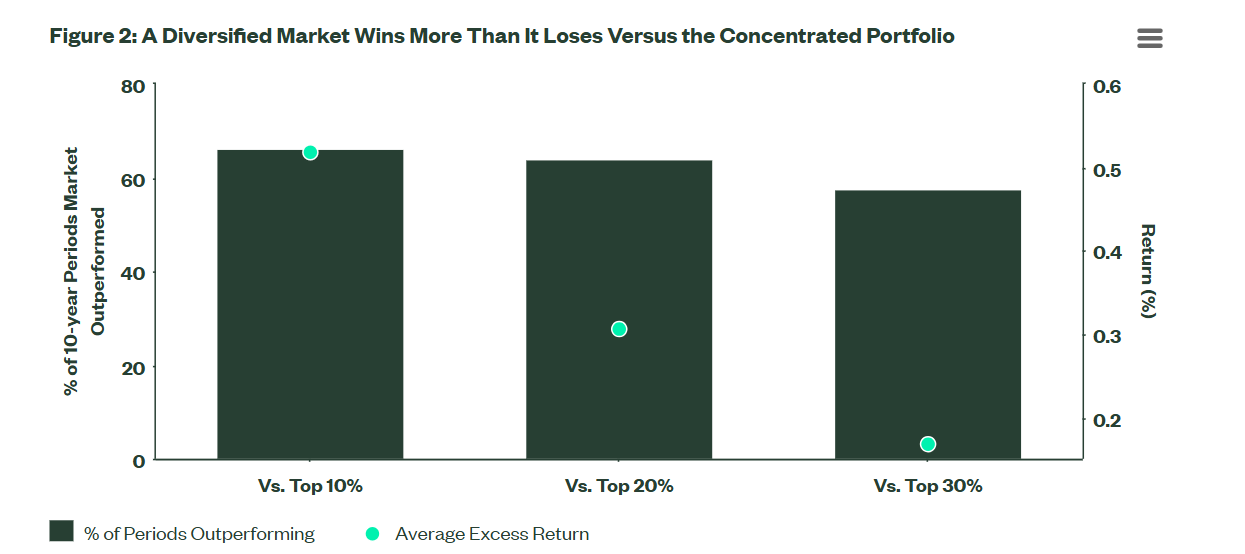
Similarly, using 10-year rolling returns data, Bartolini found that the market outperforms the most concentrated portfolio (top 10%) 66% of the time with an average annual excess return of 0.52%.
10-year rolling annual returns of a market portfolio vs 3 concentrated portfolios
Source: State Street Global Advisors
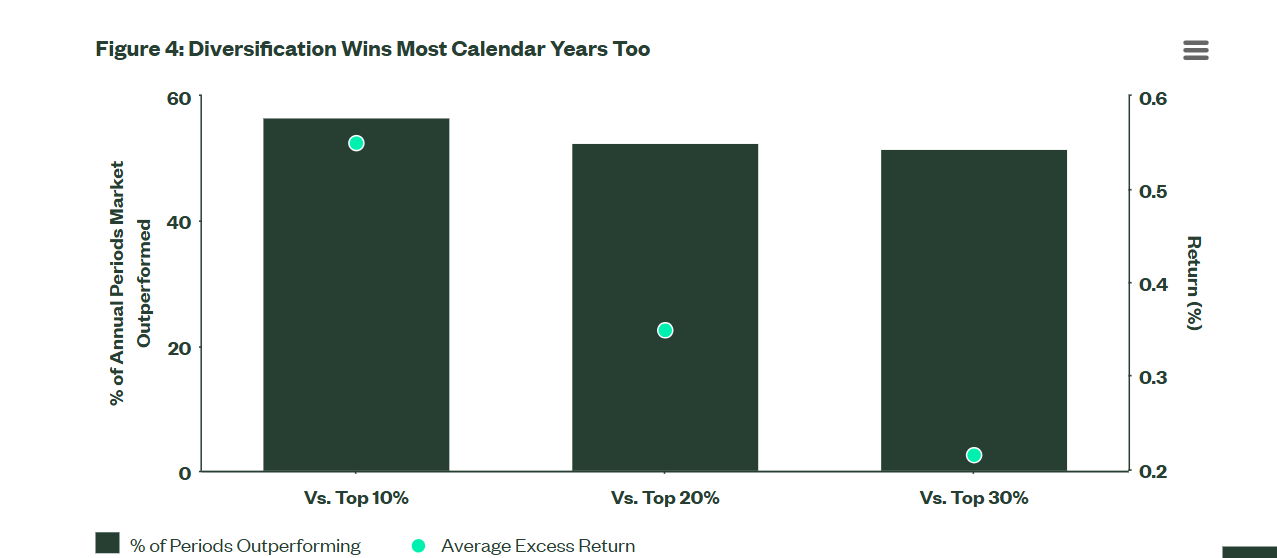
Furthermore, on an annual basis, the market has outperformed all the concentrated portfolios more than half of the time.
10-year rolling annual returns of a market portfolio vs 3 concentrated portfolios
Source: State Street Global Advisors
Lower risk
Most advocates of diversification focus on how it can reduce a portfolio’s overall risk.
“Diversifying may help reduce how much risk you take on for a level of potential return,” according to Fidelity Investments. “If you’re well diversified, then any problem that affects a specific company, or even an entire industry, may have a more limited impact on your portfolio—because no single investment accounts for a disproportionate part of your money.”
Even advocates of concentration grant that diversification reduces risk, but that is only if we interpret risk as volatility (measured by standard deviation), which is how Markowitz and William Sharpe define it.
Academic studies of both the US and Chinese stock markets have reached the same conclusion: diversification reduces risk.
The case against diversification
No free lunch
Though diversification reduces risk, that comes at the cost of lower returns, according to Drik Baur, a lecturer at the University of Western Australia. The only scenario where diversification does not involve a trade-off is if investors cannot know or do not know the risk and return of stocks and just pick them randomly.
However, the SSGA study above shows that a diversified portfolio can outperform a concentrated one.
Interestingly, advocates of diversified portfolios don’t insist on this point. They agree it could underperform or outperform, but the benefit lies in the stability of returns.
“By spreading investments across a wide array of assets, investors can achieve a balance that reduces risk and enhances the potential for stable returns, truly making it the only free lunch in investing,” said Neil Rossiter, managing director of Blackdown Financial, a financial advisory firm.
Transaction costs and management complexity
Individual and professional investors building a diversified portfolio have to carry out more transactions (including portfolio rebalancing), which means higher transaction costs.
Also, managing a portfolio of 40 assets is always more complicated than managing a portfolio of ten assets. Furthermore, each asset will not receive the attention it demands, and investors may end up following the crowd or their intuition instead of doing quality research.
However, this disadvantage mainly applies to active investors. Passive investors who buy index funds or ETFs are unlikely to incur more transaction costs than an active investor with a concentrated portfolio. Similarly, managing a portfolio of a few ETFs or index funds is not intrinsically more complicated than overseeing a portfolio of a few stocks.
Charting a middle road between diversification and concentration
Avoiding over diversification
Gresham Partners has surveyed various attempts to determine an ideal number of securities in a portfolio.
John Evans and Stephen Archer suggested 15 stocks in their 1968 research paper; Burton Malkiel proposed 20 stocks in his bestseller A Random Walk Down Wall Street; Hicham Benjelloun, in a 2010 research paper reviewing Evans and Archer’s initial study, suggested that 40 stocks would provide full diversification and noted that many academics think the figure is 50.
Once a portfolio has this number of stocks, “the plateau of risk reduction is reached.” Put differently, adding more assets after this point will not significantly reduce risk.
One implication of this is that even if diversification is beneficial, there is no point going on and on with it as if more diversification always translates to greater portfolio efficiency.
Combining concentration and diversification
Rublin has suggested that “timid souls” who can’t stomach the higher risk of concentrated portfolios can blend concentrated and indexed assets.
Gresham Partners has a similar strategy. They build clients’ portfolios using a “core and satellite framework.” The core of the portfolio “might be a low-cost passively managed index fund or, better still, a tax-managed index-tracking strategy where the underlying portfolios are lower-fee, widely diversified, and highly liquid.”
However, the satellite part of the portfolio focuses on generating alpha through a concentrated strategy. “Gresham’s reputation for generating long-term performance rests on our ability to identify strategies across the global capital markets where active management is best suited for driving excess returns, and in turn identifying the best managers to implement those strategies,” they explain. “For these so-called alpha satellites, we must embrace concentration to generate better-than-benchmark performance.”
Another approach is to diversify across various concentrated portfolios. “When you combine several concentrated portfolios using noncorrelated strategies, you have the best chance of beating a benchmark,” according to Greg Horne, cofounder of Ashbridge Investment Management.
Rublin explains how the Masters Select Equity Fund implemented this strategy:
“They’ve parceled out assets to six distinguished managers with distinct investment styles, and have charged each — Shelby Davis, Spiros Segalas, O. Mason Hawkins, Richard Weiss, Foster Friess, and Jean-Marie Eveillard — with buying no fewer than five, and no more than 15, favorite stocks.”
The impact of expertise and availability
There is no denying the fact that a concentrated strategy is not for everyone. Its success boils down to the knowledge, expertise, and emotional discipline of the investor or fund manager.
“Sharply limiting the number of holdings in a portfolio does not, in itself, provide any performance edge,” Rublin says. “It’s the manager who makes all the difference.”
Consequently, retail investors who don’t have the time or expertise to conduct thorough research or the emotional discipline to navigate the short-term fluctuations of a concentrated portfolio may be better off with a diversified and passive approach.
Alternatively, they can invest in several mutual funds that execute a concentrated strategy, mimicking the pattern used by the Masters Select Equity Fund, or choose a single mutual fund that has consistently delivered alpha for its clients.
Conclusion
There is no straightforward resolution to the diversification or concentration debate. Both strategies have arguments for and against them.
However, we have seen investors and fund managers combine both, suggesting that a radical discontinuity may not be necessary. Also, studies showing a plateau in the risk-reducing benefit of diversification have helped chart a middle road between the two strategies.
In the end, which strategy to choose (assuming you are interested in only one) or prioritize (if you prefer a combination of both) will depend on your risk-return profile.
“Diversification may preserve wealth, but concentration builds wealth,” said Warren Buffett. This aligns with the general belief that the former reduces risk but sacrifices return, while the latter increases return but may increase risk.
However, as we have seen, some studies show that a diversified strategy can be more profitable than a concentrated one. Also, concentration is riskier only if risk is defined as standard deviation rather than a permanent loss of capital.
Though this caveat is important, it is still generally right that more conservative investors should stick with diversification while more aggressive investors should embrace concentration either by picking stocks themselves or investing in mutual funds that do.
Leave a Reply